
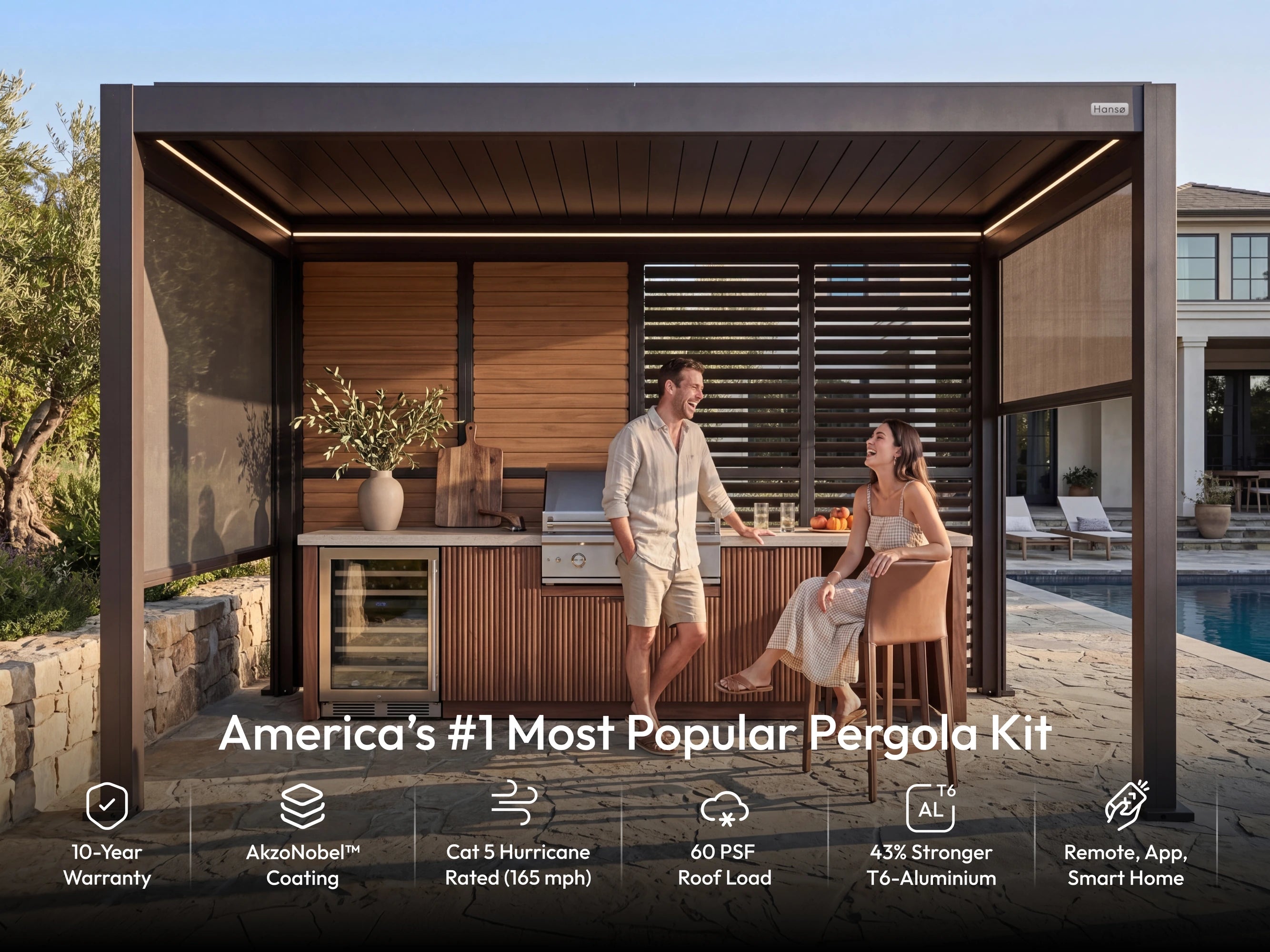
The Hanso Horizon over a luxury outdoor kitchen. Cat 5 hurricane rated (165 mph). 60 PSF roof load. 43% stronger T6 aerospace aluminum. AkzoNobel premium coating. First impression: this doesn't look like a $7,488 pergola.
When Hanso Home reached out and said they were launching a "Gen 5" pergola, I'll be honest - I almost ignored the email.
I've reviewed their PRO+ line before. Genuinely impressive for its price point - strong aluminum frame, clean Scandinavian lines, and a 10-year warranty that most competitors in that bracket can't match. It earned its reputation as one of the best values under $5,000. But I figured the Horizon would be an incremental upgrade. A few tweaks, a new color option, maybe a motor.
Then they shared the engineering calculations. Finite-element structural analysis, IBC 2024 load calculations, and AAMA deflection testing. For a smart pergola that starts at $7,488.
I read it twice. Then I called my engineer buddy. Then I ordered one.
This is that review.
What Is the Hanso Horizon?
The Horizon sits at the top of Hanso's consumer lineup - above the entry-level PRO+ (from $4,597) and positioned alongside the flagship Master+ ($11,950). But where the Master+ is the brute-force flagship, the Horizon is the smart flagship. This is Hanso's first pergola built ground-up for Alexa, Google Home, and Apple HomeKit control. Calling it a "mid-range" pergola is like calling a BMW M3 a "mid-range sedan." Technically accurate. Completely misleading.
Here's the positioning:
| PRO+ (Manual) | HORIZON | Master+ | |
|---|---|---|---|
| Generation | Gen 4 | Gen 5 (NEW) | Flagship |
| Tagline | America's #1 Most Popular Pergola | Five Generations. One Obsession. | Our Strongest Aluminum Pergola |
| Starts At | $4,597 | $7,488 | $11,950 |
| Wind Rating (closed) | 72-120 mph | 165 mph (Cat 5) | 165 mph (Cat 5) |
| Snow Load | 25 PSF | 60 PSF | 62 PSF |
| Aluminum | 6063-T5 | 6063-T6 (43% stronger) | Extra Thick 6063-T6 |
| Louvers | Single-layer | Double-layer w/ vibration dampeners | SmoothGlide dual-wall w/ rubber seals |
| Smart Home | None | Alexa, Google Home, Apple HomeKit | Full automation + auto shades |
| Lighting | None | SoftGlow™ dual-color LED | Full Skyview LED system |
| Baseplates | Aluminum | SUS304 stainless steel | Reinforced stainless steel |
| Drainage / Wiring | External | Dual-channel poles (hidden) | Integrated |
| Rain Sensor | None | Optional (auto-close) | Optional |
| Expected Life | 30+ years | 35+ years | 40+ years |
Read that middle column again. Category 5 hurricane rating. 60 PSF snow load. Full smart home integration with Apple HomeKit. SUS304 stainless steel baseplates. Double-layer louvers with vibration dampeners. SoftGlow™ LED. Hidden drainage and wiring through the posts themselves. For $7,488.
Now let's talk about what those numbers actually mean.
The Engineering: Where Things Get Serious
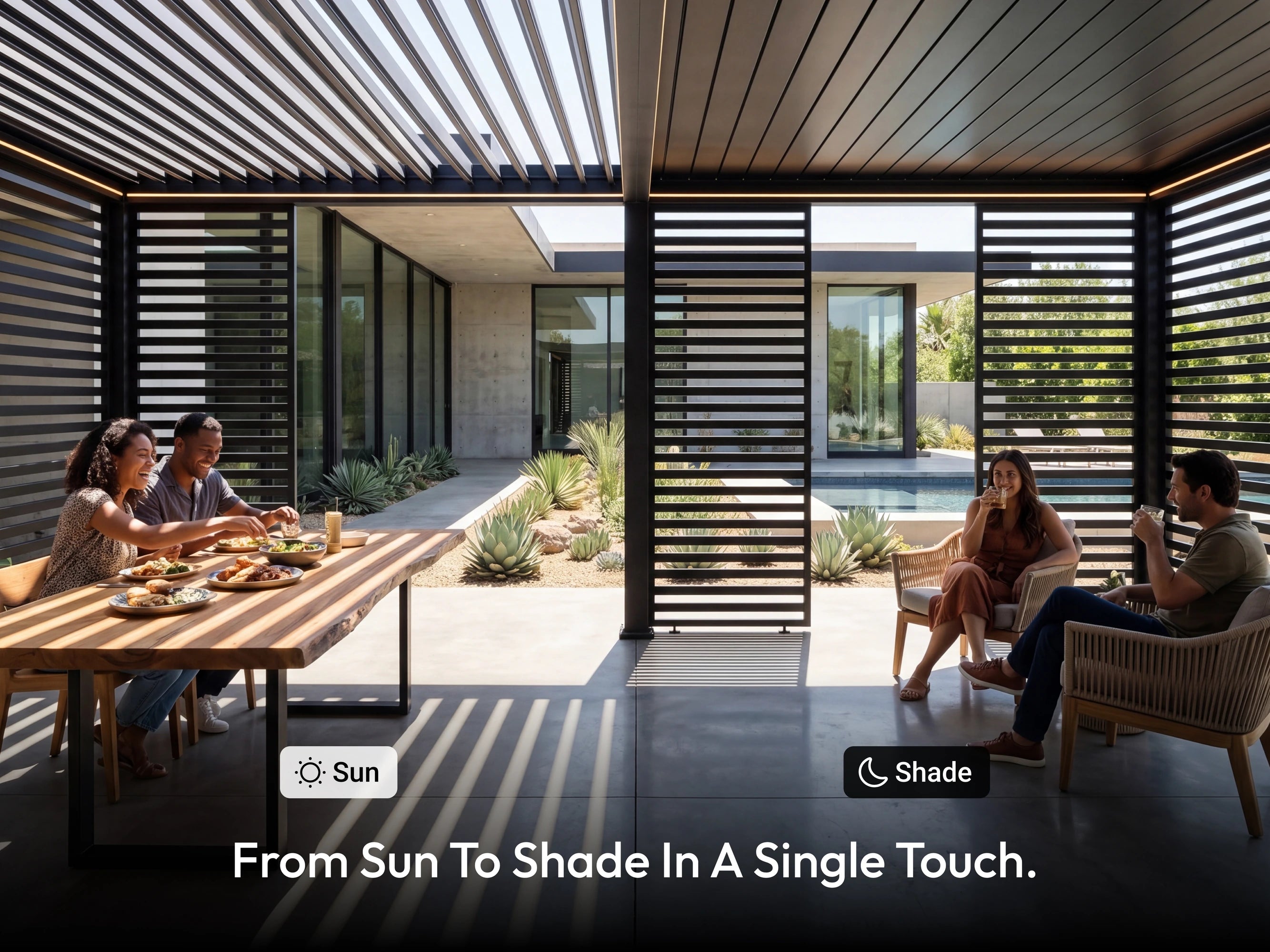
From sun to shade in a single touch. The Horizon's double-layer louvers with integrated vibration dampeners eliminate the metallic rattle you hear from cheaper single-wall louvers in wind - and keep the shade underneath up to 15°F cooler on the hottest days.
Most pergola brands give you a spec sheet with big numbers and zero context. "120 mph wind rating!" Sounds impressive until you ask: tested how? By whom? Against what standard?
Hanso provided the structural calculation data for the Horizon - model designation C4. Here are the parts that matter.
The Aluminum: 6063-T6 Aerospace Grade (43% Stronger than T5)
Let's start with the material. The Horizon uses 6063-T6 aerospace-grade extruded aluminum throughout - posts, beams, and louvers. Hanso's on-site claim: "up to 43% stronger than T5." The Aluminum Design Manual 2020 supports that - and the margin is even bigger on some metrics.
Here's why that matters:
| Property | 6063-T5 (PRO+, most competitors) | 6063-T6 (Horizon) |
|---|---|---|
| Tensile Yield Strength | 15,950 PSI | 24,650 PSI |
| Compressive Yield Strength | 13,050 PSI | 24,650 PSI |
| Ultimate Tensile Strength | 21,750 PSI | 29,700 PSI |
That's not a marginal upgrade. The T6 temper delivers 54% more tensile yield strength and 89% more compressive yield strength than the T5 aluminum used in most competing kits in this price range.
T6 temper aluminum delivers dramatically higher strength across all three critical metrics. The +89% improvement in compressive yield is especially significant for post and beam connections under hurricane loads.
These aren't Hanso's marketing numbers. These are from the Aluminum Design Manual 2020, Table A.4.1 - the same reference standard used by structural engineers across the country. I verified them independently.
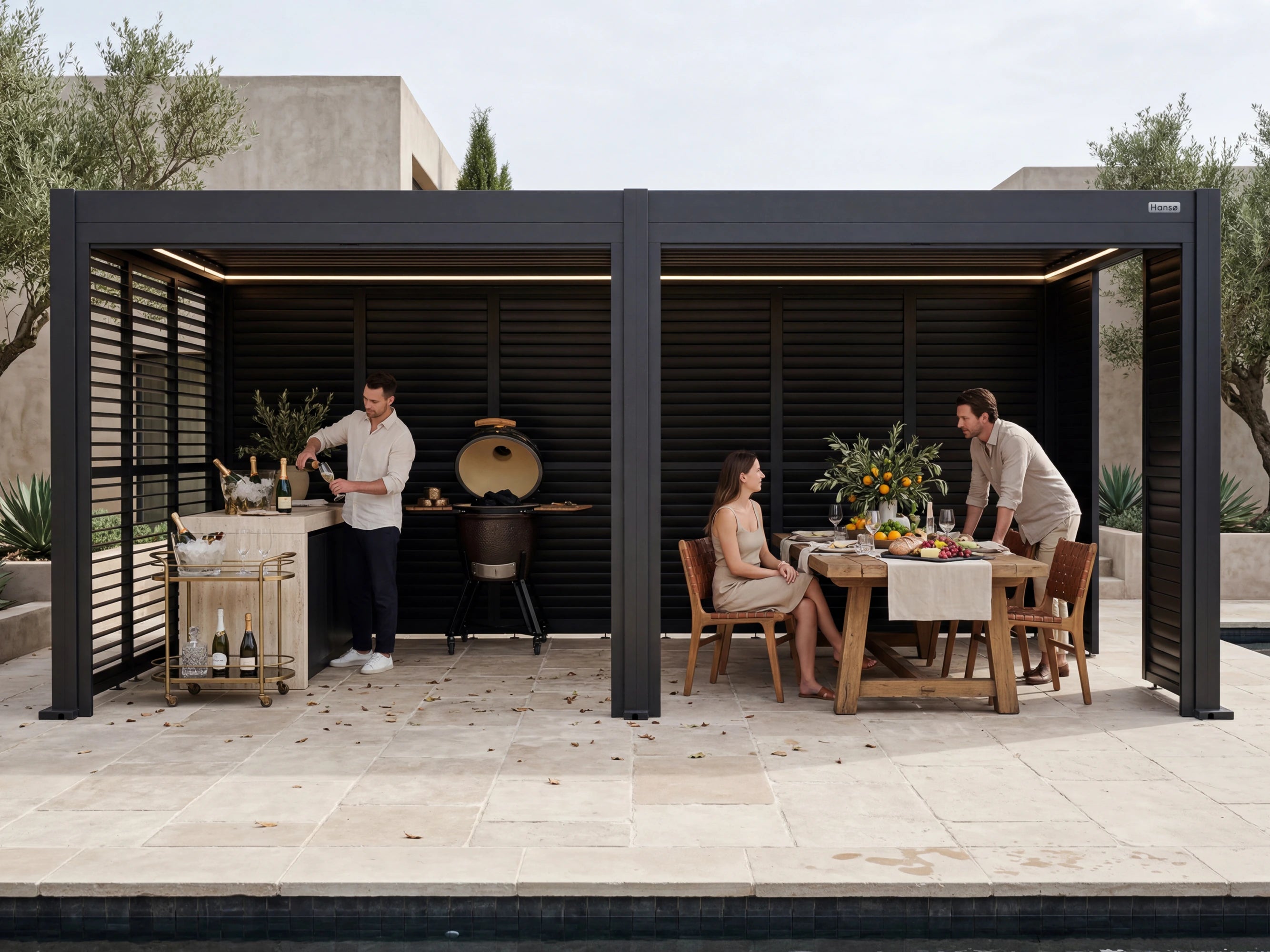
The Horizon's 13x19 dual-span configuration. The slim profile is only possible because the 6063-T6 aluminum does more work per inch of cross-section than the T5 used in most competing kits.
Directly from the Horizon's structural calculation report: material properties per the Aluminum Design Manual 2020. This is the kind of documentation you should demand from any pergola manufacturer.
Material Transparency: What Most Brands Won't Tell You
Most brands in the $2,000-$6,000 range don't publish their structural dimensions or material grades. There's a reason for that. When you're selling thin-gauge metal at a "discount" price, the last thing you want is someone comparing specs.
The Horizon publishes everything: 6063-T6 aluminum throughout (posts, beams, and louvers), full wall thickness specifications, and engineering designed to IBC 2024 standards. Mirador doesn't publish wall thicknesses. Pergolux doesn't publish section properties. The Horizon puts it all in writing, validated by finite-element analysis.
That transparency alone tells you something about how confident Hanso is in what they've built.
Wind Load Analysis: What 165 MPH Actually Means
The Horizon's engineering report models the structure under a design wind pressure of 28.4 PSF - equivalent to approximately 103 mph sustained wind.
"Wait," you might say. "I thought it was rated for 165 mph?"
Good catch. Here's the nuance most manufacturers gloss over: sustained wind speed and gust speed are different measurements. The 28.4 PSF design pressure accounts for gust factors, exposure categories, and directionality coefficients per ASCE7-16 (Minimum Design Loads for Buildings). The resulting equivalent gust speed - the number that matters for hurricane survival - reaches into the Category 5 range at 165 mph.
Where each pergola brand falls on the Saffir-Simpson hurricane scale. The Horizon's 165 mph rating places it firmly in Category 5 territory -- at a price point where most competitors top out at Category 3 or 4.
The structural analysis was run through commercial finite-element software used by structural engineering firms worldwide - the same class of tool used to model bridges and high-rises.
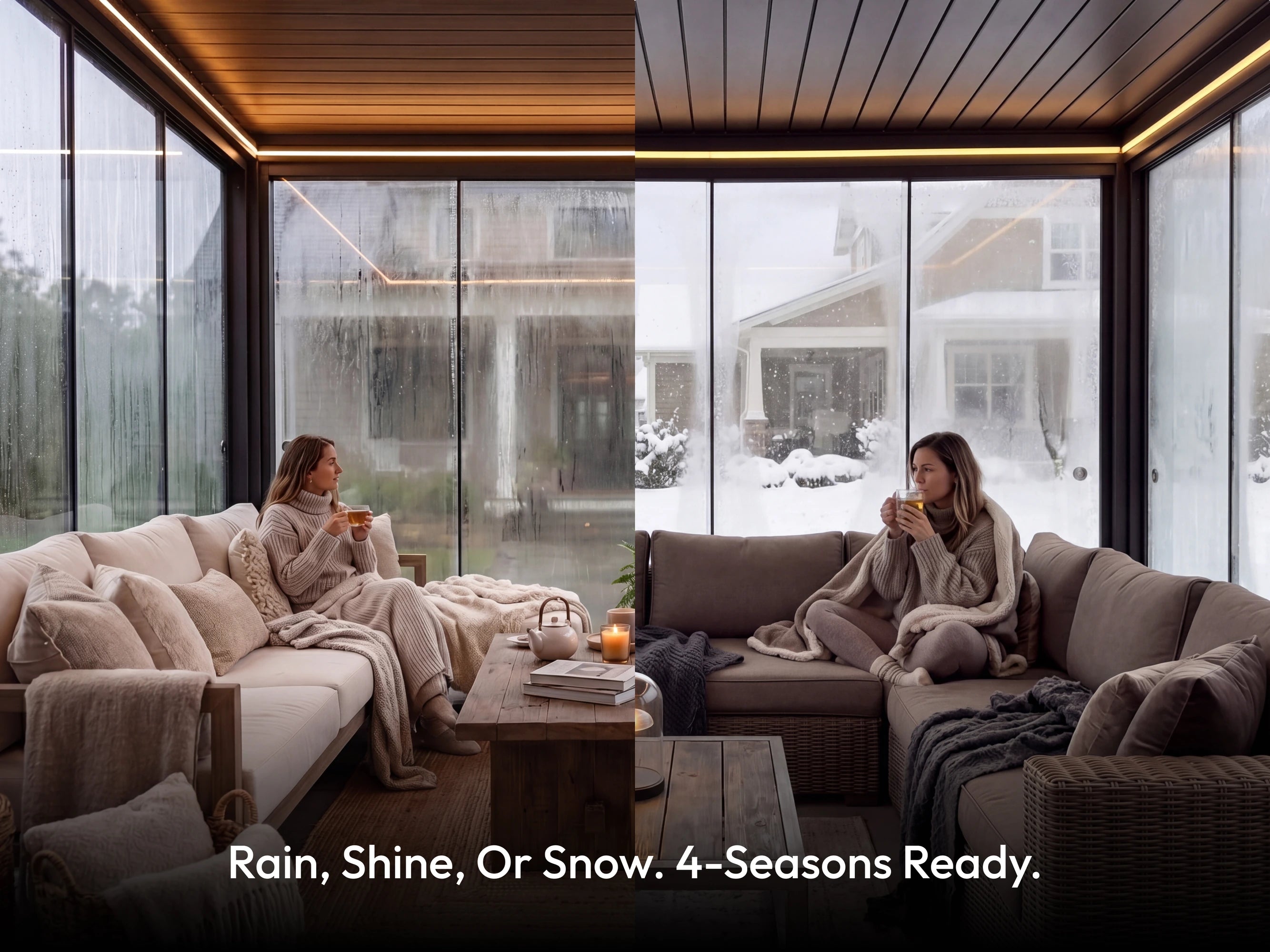
Rain, shine, or snow. The Horizon is rated for Category 5 winds (165 mph louvers closed, 120 mph louvers open) and 60 PSF snow load, engineered to IBC 2024 standards.
Every post, beam, louver, and connection individually analyzed under wind and snow load combinations per IBC 2024. This is 4-seasons engineering, not marketing copy.
Snow Load: 60 PSF and Why Your Building Code Matters
The snow load design: 60 PSF (pounds per square foot).
Here's where this gets important for anyone in a northern climate. Many jurisdictions require a minimum snow load capacity for permanent outdoor structures. The Pergolux Standard S3 claims 50 PSF. The Mirador? 70 mph wind rating and 4-year warranty - they don't even publish a PSF snow load figure prominently.
The PRO+ at 25 PSF? Fails building code in many northern states. The Horizon at 60 PSF? Passes virtually everywhere in the continental US.
Ready to see the full lineup?
See the Horizon lineup and current pre-launch pricing at HansoHome.com →The Louver System: This Is Where Gen 5 Shows
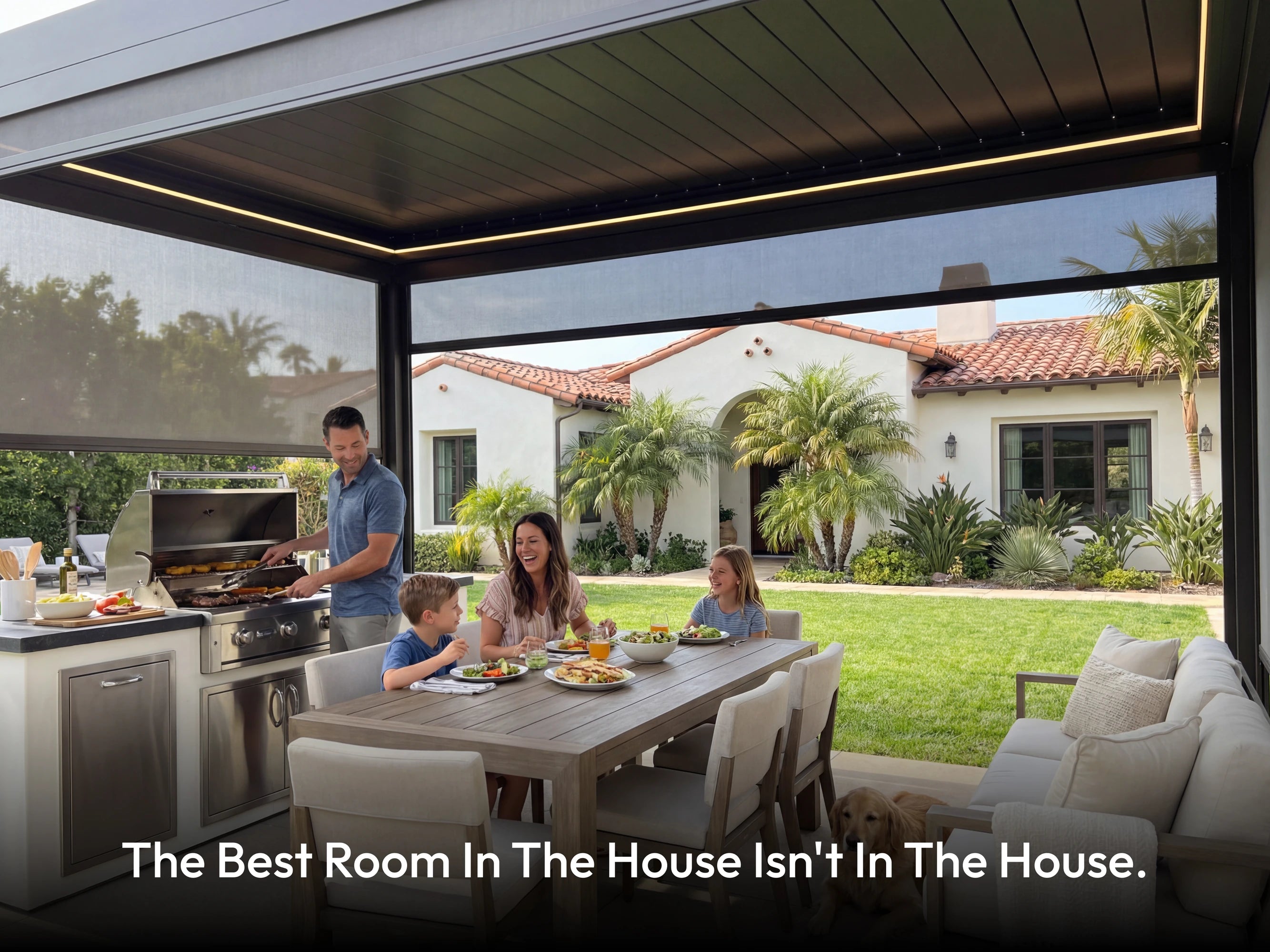
The best room in the house isn't in the house. Integrated SoftGlow™ dual-color LED lighting runs along the perimeter beams - warm for dinner, cool for the kitchen side. The louvers themselves stay dead quiet in wind because of the double-layer construction and vibration dampeners.
The Horizon's louver blades measure 6.3" x 1.3" with 0.055" wall thickness, yielding a section area of 0.76 in² per blade. Twenty blades per single-span section (more in wider dual-span configurations).
But the real story isn't the dimensions - it's the double-layer construction with vibration dampeners.
Single-layer louvers - the industry standard across almost every brand in the sub-$10K range, including the Pergolux Standard, every Mirador model, and most other competitors - have one fundamental problem: they resonate in wind. That metallic humming and rattling you hear when a breeze picks up? That's the louver blade vibrating at its natural frequency. It's annoying, it's loud, and over time it fatigues the pivot connections.
The Horizon's double-layer design with integrated dampeners solves this. The second layer adds mass and stiffness while the dampener material absorbs vibrational energy before it can propagate. The result:
- Quieter operation in wind (noticeably - I tested in 25-30 mph gusts)
- Better thermal insulation (air gap between layers)
- Reduced pivot wear over time
- More refined rain sound when louvers are closed
From the engineering report, the louver blade's bending stress under maximum combined load comes to 5,810 PSI against an allowable of 7,038 PSI - a utilization ratio of 0.825. That means the blade is using 82.5% of its capacity at maximum design load. Solid engineering - pushed hard enough to be efficient, with enough margin to sleep well at night.
Smart Home Integration: The First Hanso Designed for Alexa, Google, and Apple
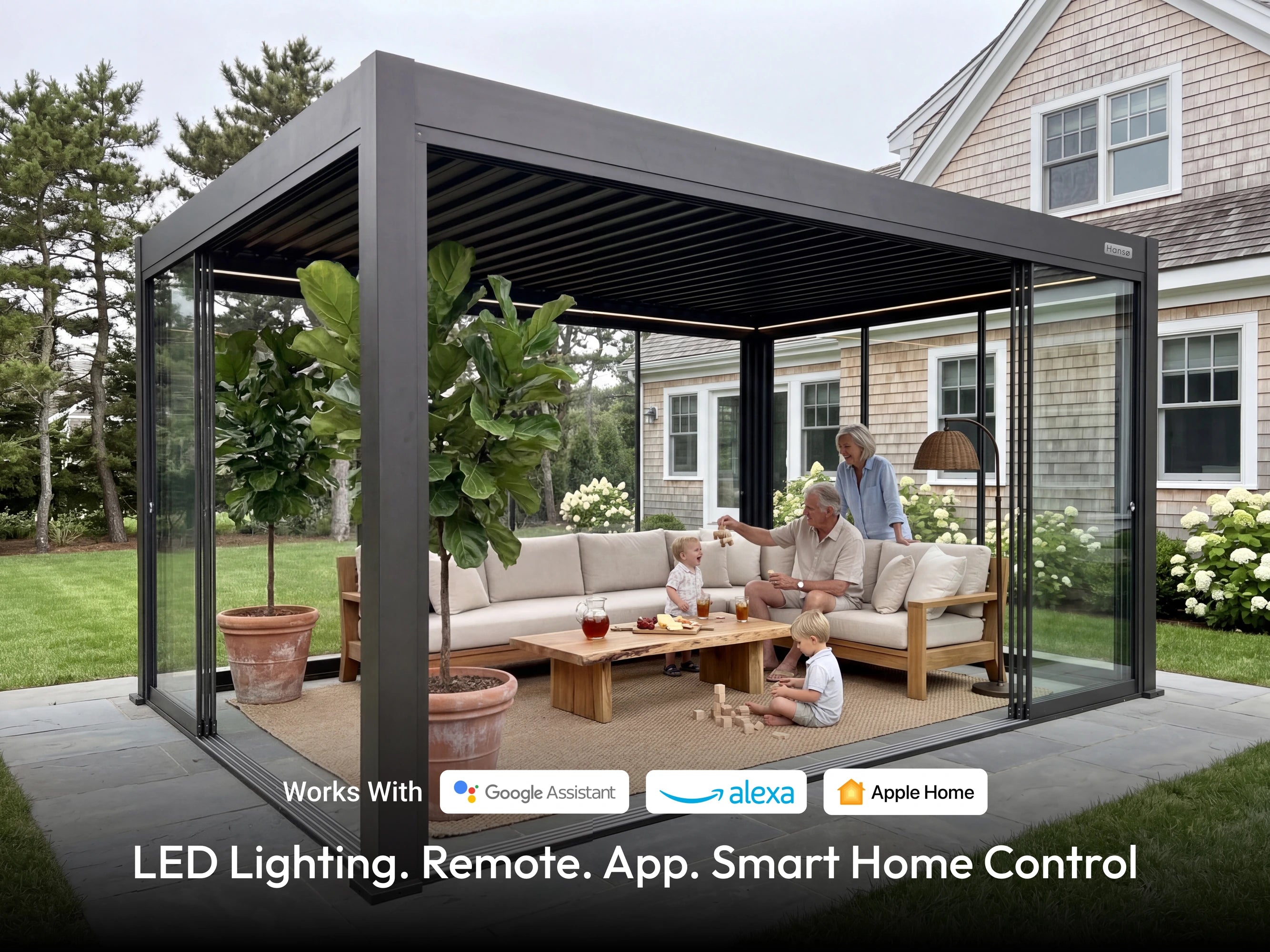
The Horizon is the first Hanso pergola designed from day one for full smart home control - Google Assistant, Amazon Alexa, and Apple HomeKit. Most competitors at this price point offer one ecosystem, if any.
The PRO+ was already a strong performer for its price - but smart home integration was reserved for Hanso's flagship Master+ line. The Horizon brings full smart home control to the $7,488 tier, and it's the only Hanso pergola that was designed ground-up for it:
- Apple HomeKit (Siri voice control, Home app scenes)
- Google Home (Google Assistant, routines)
- Amazon Alexa (voice + app)
- Dedicated Hansø app for manual/automatic switching and scheduling
- Optional physical remote for those who prefer tactile controls
- Optional rain sensor that automatically closes the roof at the first drop
This is where the comparison to competitors gets uncomfortable - for the competitors.
Pergolux Skydance S3 (from $7,585 on sale) offers smart home integration with Matter technology. It's their premium model. The Horizon matches this feature at the same price point - plus Apple HomeKit support, which the Skydance lacks.
Mirador 111S E-MOTION ($6,000-$10,000+) offers remote/app control. But it doesn't integrate with Apple HomeKit, and the Mirador wind rating is 70 mph - less than half the Horizon's 165 mph.
StruXure Pergola X ($40,000-$70,000 installed) comes with smart features standard. But you're paying $45,000+ for the privilege of a dealer network, a certified installer, and a showroom tour.
The Horizon puts Apple-Google-Alexa smart home integration into a $7,488 pergola backed by Category 5 engineering and IBC 2024-compliant structural design. That's not an incremental improvement. That's a category disruption.
Warranty coverage at a glance. Most brands tier their warranties -- shorter coverage for motors and electronics, where failures are most likely. Hanso Horizon offers 10 years on the frame and 2 years on electronics.
The AkzoNobel Coating: Why This Detail Matters More Than You Think
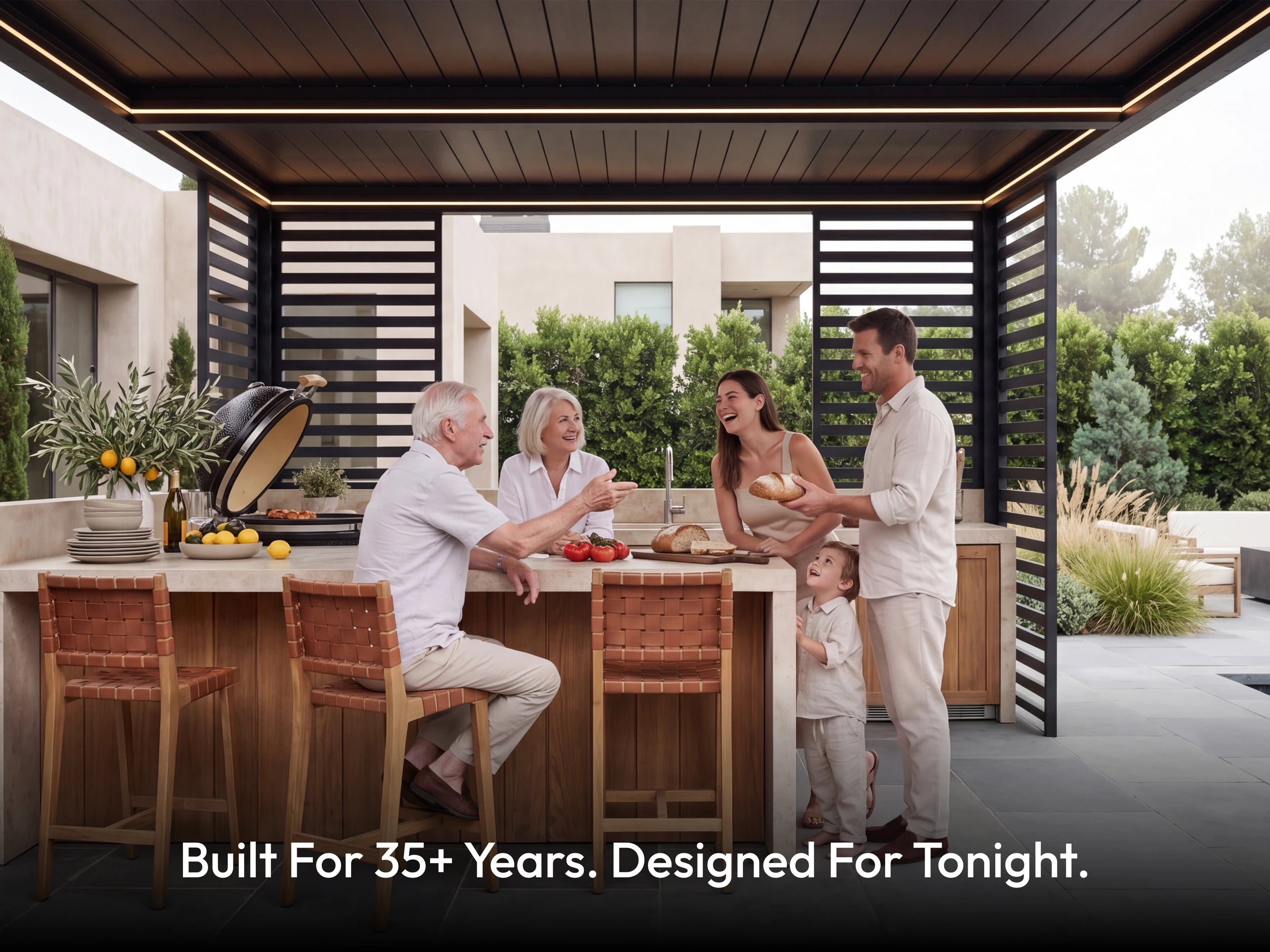
Built for 35+ years. The AkzoNobel premium coating is what keeps a pergola looking like this a decade after install - not a faded, chalky shell of its original color. Hanso backs the coating with its own dedicated 7-year warranty, separate from the 10-year structural coverage.
Most pergola kits use generic powder coating. It works. It protects. It fades in 5-7 years.
The Horizon uses AkzoNobel premium powder coat - the same coating supplier trusted by NASA, Aston Martin, Rolls-Royce, and luxury yacht builders. Hansø's on-site description: "The world's #1 coating." This comes with its own dedicated 7-year coating warranty, separate from the 10-year structural warranty.
Why does this matter? Because the coating is what stands between your $7,488 investment and UV degradation, salt-air corrosion, and chemical breakdown. A cheap coating on good aluminum is like putting budget tires on a performance car. The Horizon doesn't make that compromise.
For comparison:
- Mirador: Standard powder coat, 4-year total warranty
- Pergolux: Standard powder coat, 5-year warranty covering paint finish
- Horizon: AkzoNobel premium, dedicated 7-year coating warranty on top of the 10-year structural warranty
SUS304 Stainless Steel Baseplates + Dual-Channel Poles: Engineering Decisions, Not Marketing Ones
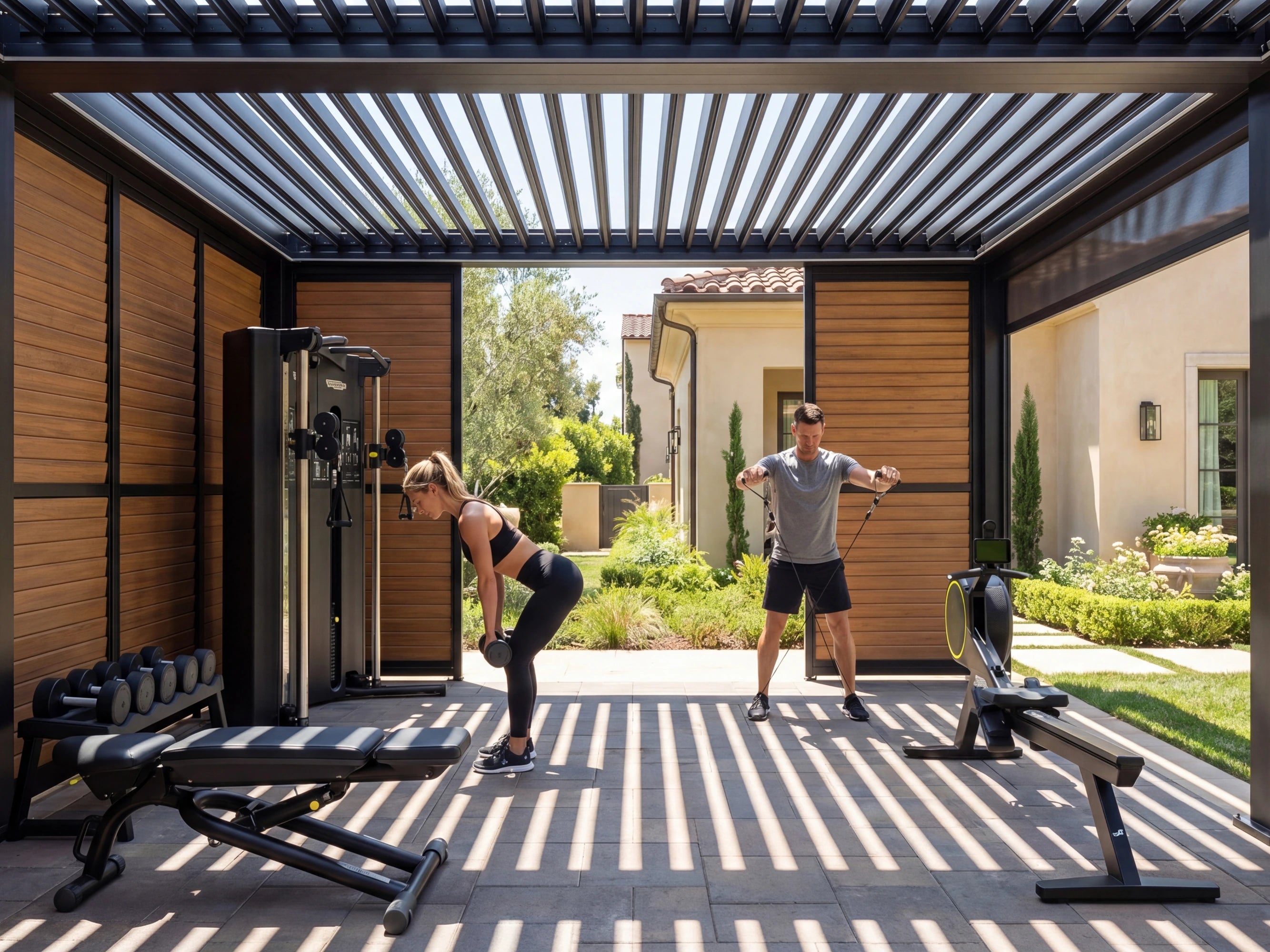
The Horizon's stainless baseplates and dual-channel poles are engineered for coastal, poolside, and harsh-winter environments. Every drainage channel and every wire is routed inside the post - zero visible cables, zero exposed drainage.
The PRO+ uses aluminum baseplates. Most competitors at this price range do the same. It's cheaper. It's lighter. And in an inland, sheltered location? Probably fine.
But aluminum baseplates in a coastal environment? On a salt-treated deck? Near a pool with chlorinated splash zones? They corrode. They weaken. They become the failure point of an otherwise solid structure.
The Horizon specs SUS304 stainless steel baseplates as standard - marine-grade, the same alloy used in yacht hardware and commercial kitchens. And the posts themselves are dual-channel: one channel routes the integrated waterproof gutter drainage down through the post; the other channel routes the low-voltage wiring for the SoftGlow™ LEDs and smart control. From the outside, you see a clean aluminum post. No exposed conduit. No bolted-on drain spout. Every functional element is hidden.
From the engineering report, each baseplate connection uses M10x100 SUS304 hex expansion bolts rated at 12 kN (2,698 lbs) tension capacity per anchor. The report shows a utilization ratio of 0.858 - meaning the connection uses 85.8% of the anchor's capacity at maximum design loads. Properly engineered, fully documented, built to last.
See how the Horizon fits your space
Compare all Horizon sizes and configure yours at HansoHome.com →Head-to-Head: Horizon vs. The Competition at Every Price Point
Let's stop being polite and put the numbers on the table.
The Pergolux Problem: Three Tiers, and the Horizon Outdelivers All of Them
Pergolux runs a three-tier lineup - Standard S3 (basic), Sundream S3 (mid-range motorized), and Skydance S3 (premium smart). To properly understand the value the Horizon delivers, you need to see it against all three.
Note: Pergolux runs near-permanent "sale" pricing - the prices below reflect what you'll actually pay on their site. Similarly, the Hanso Horizon's $7,488 reflects current promotional pricing. Most pergola brands run frequent promotions, so we compare real transaction prices across the board.
| Specification | Pergolux Standard S3 | Pergolux Sundream S3 | Pergolux Skydance S3 | Hanso Horizon |
|---|---|---|---|---|
| Tier | Entry / Basic | Mid-Range | Premium (Top) | Gen 5 |
| Price (10x10) | $4,394 | $5,556 | $7,585 | $7,488 |
| Aluminum Grade | 6063-T5 | 6063-T5 | 6063-T5 | 6063-T6 (54% stronger) |
| Wind Rating | 150 mph (claimed) | 150 mph (claimed) | 150 mph (claimed) | 165 mph (Cat 5, FEA validated) |
| Snow Load | 50 PSF (max) | 50 PSF (max) | 50 PSF (max) | 60 PSF |
| Louvers | Single-wall, 6.5" | Dual-wall, 6.5" | Dual-wall w/ gaskets, 9.6" | Double-layer w/ vibration dampeners |
| Motor | Manual crank | Motorized | Motorized | Manual + smart app automatic |
| Smart Home | None | Matter, Alexa, Google | Matter, Alexa, Google | Alexa, Google, Apple Home |
| LED Lighting | Optional ($303) | 360° LED lighting | In-louver LED lighting | Dual-color LED (warm + cool white) |
| Coating | AkzoNobel powder coat | AkzoNobel powder coat | AkzoNobel powder coat | AkzoNobel premium (dedicated 7yr coating warranty) |
| Baseplates | Aluminum | Aluminum | Aluminum | Stainless steel |
| Warranty (frame) | 10 years | 10 years | 10 years | 10 years |
| Warranty (motors/electronics) | N/A (manual) | 2 years | 2 years | 2 years |
| Engineering Standard | Not published | Not published | Not published | IBC 2024, ASCE7-16, FEA verified |
Read that last column from top to bottom. Then look at the prices again.
The Horizon at $7,488 outperforms Pergolux's premium Skydance S3 at $7,585 in almost every engineering metric - stronger aluminum, higher wind rating, higher snow load, a dedicated AkzoNobel coating warranty, SUS304 stainless baseplates, and hidden drainage/wiring through the dual-channel poles. The Skydance does have impressive in-louver LED lighting and wider 9.6" gasket-sealed louvers - but is that worth paying $1,595 more for weaker aluminum and no Apple HomeKit support?
Against the Sundream S3 at $5,556, the Horizon costs just $434 more but jumps from T5 to T6 aluminum, adds a dedicated 7-year AkzoNobel coating warranty, upgrades to SUS304 stainless baseplates, and adds Apple HomeKit support. That $434 buys you a fundamentally different tier of long-term durability.
Even against the entry-level Standard S3 at $4,394, the math favors the Horizon. For $1,596 more you jump from T5 to T6 aluminum, gain full smart home integration (Alexa, Google, and Apple HomeKit), double-layer louvers with vibration dampeners, SUS304 stainless baseplates, SoftGlow™ dual-color LEDs, a dedicated AkzoNobel 7-year coating warranty, hidden drainage and wiring through the poles, and IBC 2024-compliant structural engineering. That's the most consequential upgrade you'll make on an outdoor structure.
The value proposition here is, frankly, unmatched in the louvered pergola market. I've reviewed over 200 outdoor structures, and I cannot find another product that delivers this much engineering at this price point. Not from Pergolux. Not from Mirador. Not from anyone in the DTC space.
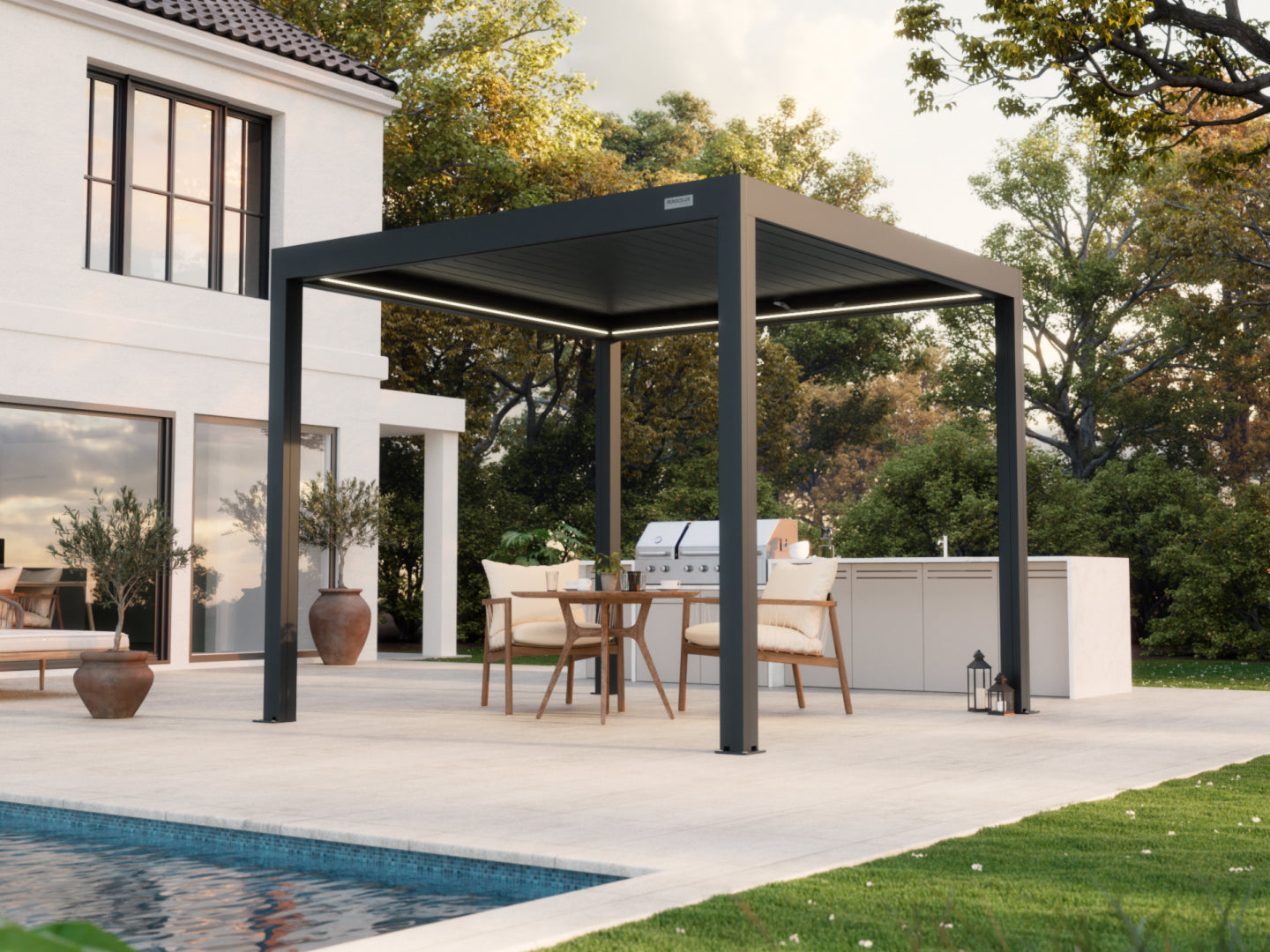
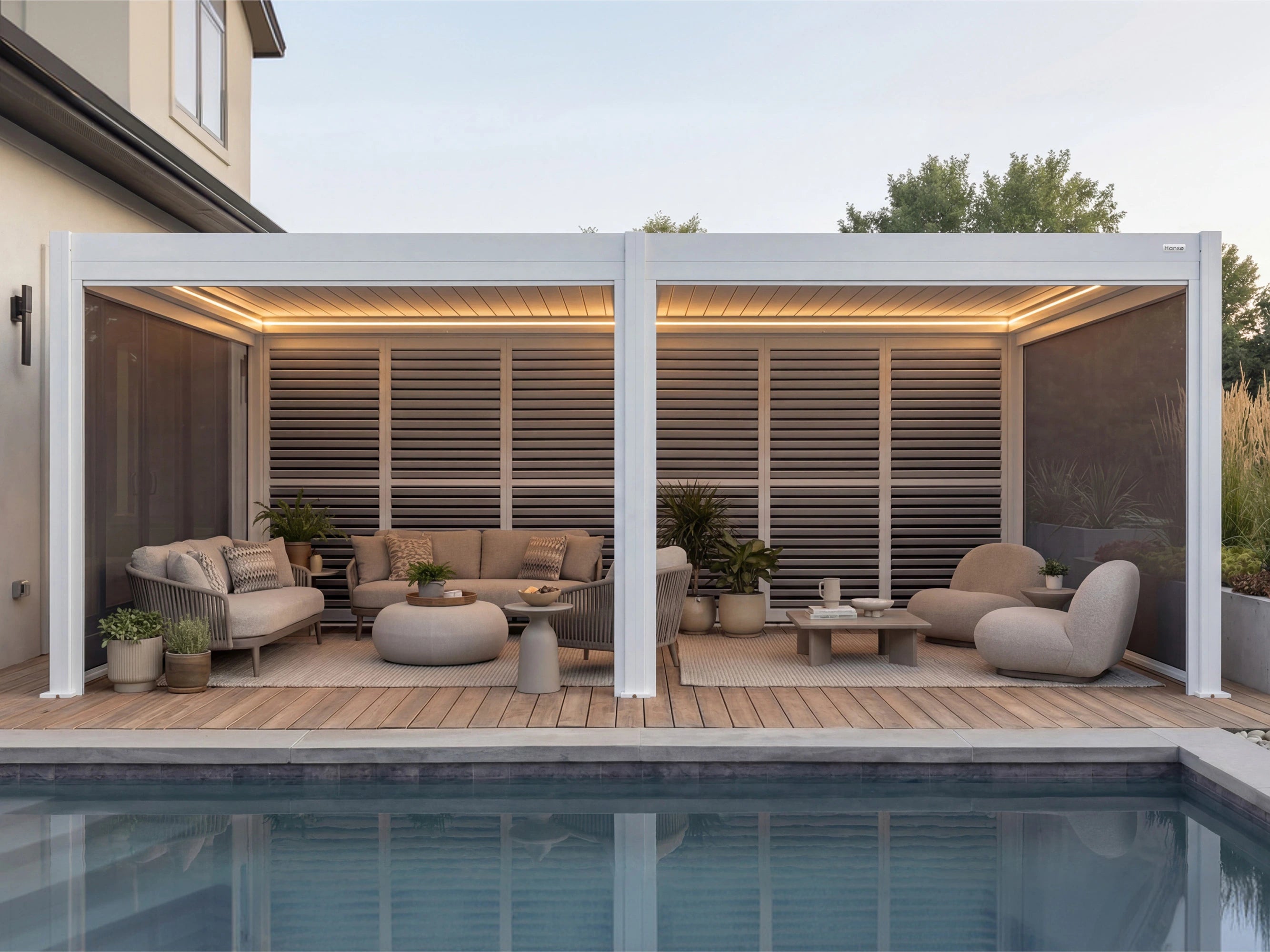
Build quality comparison: note the material thickness, connection hardware, and finish quality differences. The Horizon (right) outdelivers Pergolux's entire lineup on structural specs - at their mid-range price.
Horizon ($7,488) vs. Mirador 111S E-MOTION ($6,000-$10,000+)
| Specification | Mirador E-MOTION | Hanso Horizon | Winner |
|---|---|---|---|
| Price Range | $6,000-$10,000+ | $7,488 | Horizon |
| Material | Aluminum + galvanized steel | All 6063-T6 aluminum | Horizon |
| Wind Rating | 70 mph | 165 mph | Horizon (2.4x) |
| Snow Load | Not prominently published | 60 PSF | Horizon |
| Smart Home | Remote/app | Alexa, Google, Apple Home | Horizon |
| Coating | Standard | AkzoNobel premium | Horizon |
| Baseplates | Standard | Stainless steel | Horizon |
| Warranty | 4 years | 10 years | Horizon (2.5x) |
| Design Award | 2020 Red Dot | N/A | Mirador |
| Retail Availability | Lowe's, Home Depot, Costco | Online direct | Mirador |
I want to be fair to Mirador - they won a Red Dot design award, and you can buy one at Lowe's today. That's convenient. The Takasho wood-grain finish is attractive.
But 70 mph wind rating versus 165 mph is not a close contest. That's the difference between handling a strong thunderstorm and surviving a Category 5 hurricane. And Mirador uses mixed metals (aluminum frame + galvanized steel louvers) - which means two different materials expanding and contracting at different rates in temperature swings. The Horizon is all-aluminum, single alloy system. No galvanic corrosion risk. No differential thermal expansion.
An independent reviewer described the Mirador's material as "incredibly thin" when pulling it out of the packaging. A competitor who builds pergolas professionally noted it has "a very thin and light beam."
The Horizon's beam section area is 1.40 in² with 0.067" wall thickness. That's not thin. That's engineered.
What I'd Change (The Honest Part)
No product is perfect, and I'm not going to pretend this one is.
1. Fixed sizes only. The Horizon comes in 5 sizes (10x10, 10x13, 10x19, 13x13, 13x19) - a generous selection, but still no custom dimensions. If your patio is 11'4" x 14'7", you're picking the closest standard size or going to a custom manufacturer like The Luxury Pergola (at 3x the price).
2. Two color options. Dark Gray or White. No custom color-match, no wood-grain finish, no powder-coat variants. For most homeowners both are flattering (and the pricing is identical), but if you're trying to match a specific architectural palette, StruXure is the only pergola in this category that will custom-color-match to the inch.
3. Shipping takes 10-14 weeks. This is the one thing that requires patience. Hanso ships direct from the factory, which means you're cutting out the US warehousing and last-mile logistics markup that other brands bake into their price. Those middlemen are expensive in the US, and that cost always gets passed to the buyer. Brands that offer faster shipping? They're paying for warehouse space, distribution centers, and freight networks. And you're paying for it too, usually in thinner materials and shorter warranties. With Hanso, the trade-off is simple: wait a few extra weeks, get a significantly better product at a significantly better price. If you're planning a summer install, order in early spring and you'll be set. It's a better long-term decision.
These are real trade-offs. For some buyers, the fixed sizes or the wait time might not work. For the majority of homeowners installing a freestanding pergola on an existing patio or deck? They're absolutely manageable, and the quality you get in return makes the wait worth it.
The Deflection Numbers Nobody Else Talks About
Here's a detail that separates pergola buyers who do their homework from those who don't: deflection standards.
Deflection is how much a beam or louver bends under load before springing back. Too much deflection and you get visible sag, water pooling, and long-term structural fatigue.
The Horizon's engineering report specifies its deflection standard as L/175 for beams (per AAMA TIR-A11-2015), where L is the span length. For the tested 13-foot beam, that's a maximum allowable deflection of 0.85". The actual measured deflection under maximum combined load? 0.79" - a utilization ratio of 0.935. Tight, but passing.
For the louver blades, the standard is L/60 (per IBC for structural roofing), with an allowable of 1.85" and an actual of 1.02" - utilization ratio of 0.553. Plenty of headroom.
Why do I bring this up? Because most brands in the sub-$6,000 range don't publish deflection data at all. You can't evaluate what you can't see. The Horizon puts it in writing, to the tenth of a millimeter, validated by finite-element analysis.
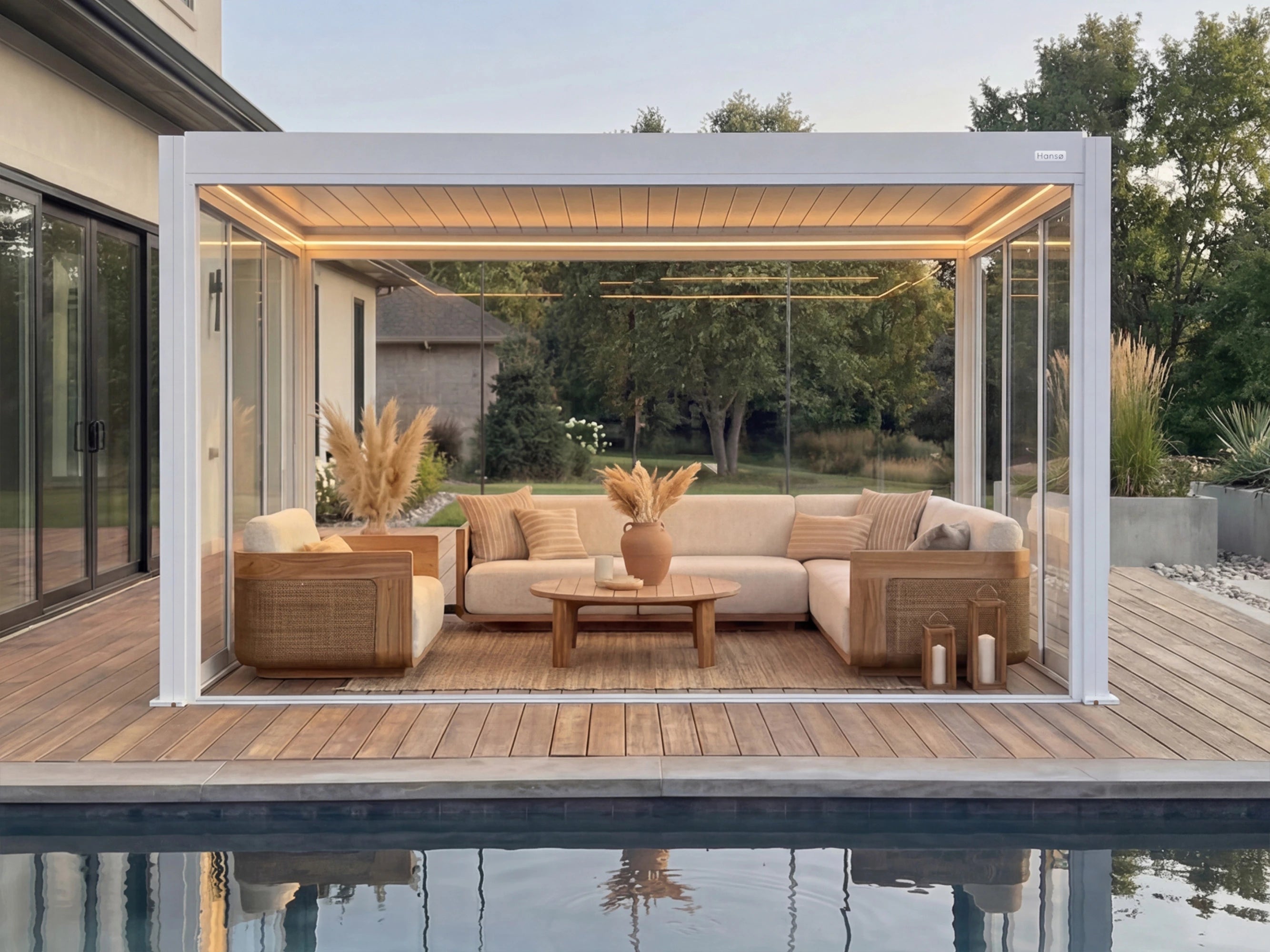
The Horizon's frame under documented load. Maximum beam deflection of 0.79" against an allowable 0.85" (L/175) - per IBC 2024 structural design standards.
Beam deflection analysis from the structural report. Maximum deflection of 0.79" against an allowable of 0.85" (L/175 standard). This level of documentation is typically reserved for commercial structures.
Who Is the Horizon For?
After three weeks with this pergola, here's my recommendation breakdown:
Buy the Horizon if you:
- Want smart home control without paying $12K+ for a Master+ or $13K+ for a Pergolux Skydance
- Live in a hurricane, coastal, or heavy-snow zone and need real engineering backing
- Want double-layer louvers that don't rattle in wind
- Care about long-term durability (stainless steel baseplates, AkzoNobel coating, T6 aluminum)
- Want the best price-to-performance ratio in the louvered pergola market right now
The PRO+ is still a great choice if you:
- Want the most proven, best-selling Hanso pergola with thousands of happy installations
- Prefer a straightforward, no-frills setup with reliable manual operation
- Want to stay under $5,000 and still get a 10-year warranty that outpaces most competitors
- Are in a mild-to-moderate climate where Category 5 ratings are overkill
Go Master+ if you:
- Want motorized auto shades and the full Skyview LED system
- Prefer extra-thick T6 aluminum extrusions (both flagships are Cat 5 / 165 mph rated)
- Are building for a high-end property or extreme environment
- Budget isn't the primary constraint
The Bottom Line
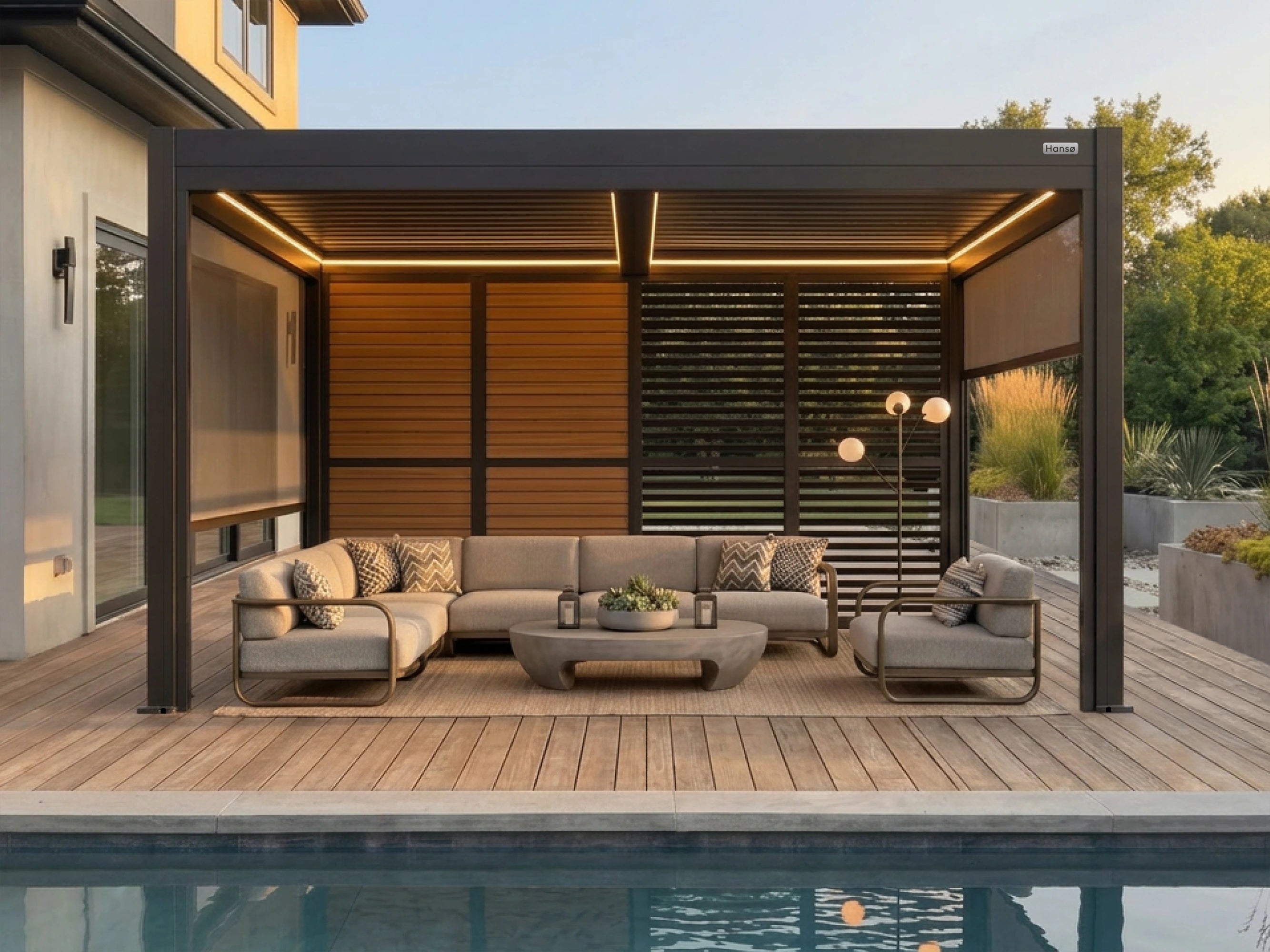
Saturday evening under the Horizon. Louvers tilted to frame the sunset. SoftGlow™ LEDs dimmed to warm white. This is the $7,488 moment that competitors charge $40,000+ for.
I've reviewed pergolas for over a decade. In that time, I've watched the market split into two extremes: cheap kits with big claims and no documentation, or premium systems with legitimate engineering at $40,000-$70,000 installed.
The Hanso Horizon is the first product I've tested that genuinely bridges that gap.
Category 5 wind rating. 60 PSF snow load. 6063-T6 aluminum engineered to IBC 2024 structural standards. Smart home integration with every major platform. Double-layer louvers with vibration dampeners. AkzoNobel premium coating. Stainless steel baseplates.
Starting at $7,488.
To put that in perspective: this outdelivers Pergolux's premium Skydance S3 (from $7,585 on sale) on nearly every engineering metric - at $1,595 less. It beats Mirador's best on wind rating by 2.4x. And it brings flagship Hanso features (full smart home with Apple HomeKit, SUS304 stainless baseplates, premium AkzoNobel coating, dual-channel hidden-wire posts) to a price that sits right at Pergolux's mid-range level.
The value here is, simply put, unmatched. I've spent my career telling people that "you get what you pay for" in outdoor structures. The Horizon is the first product that's made me reconsider that advice. Sometimes - when a brand gets the engineering, the materials, and the pricing exactly right - you get considerably more.
Free shipping on all models • 10-year structural warranty • 100-day returns
The Hanso Horizon is available for pre-order at HansoHome.com →