
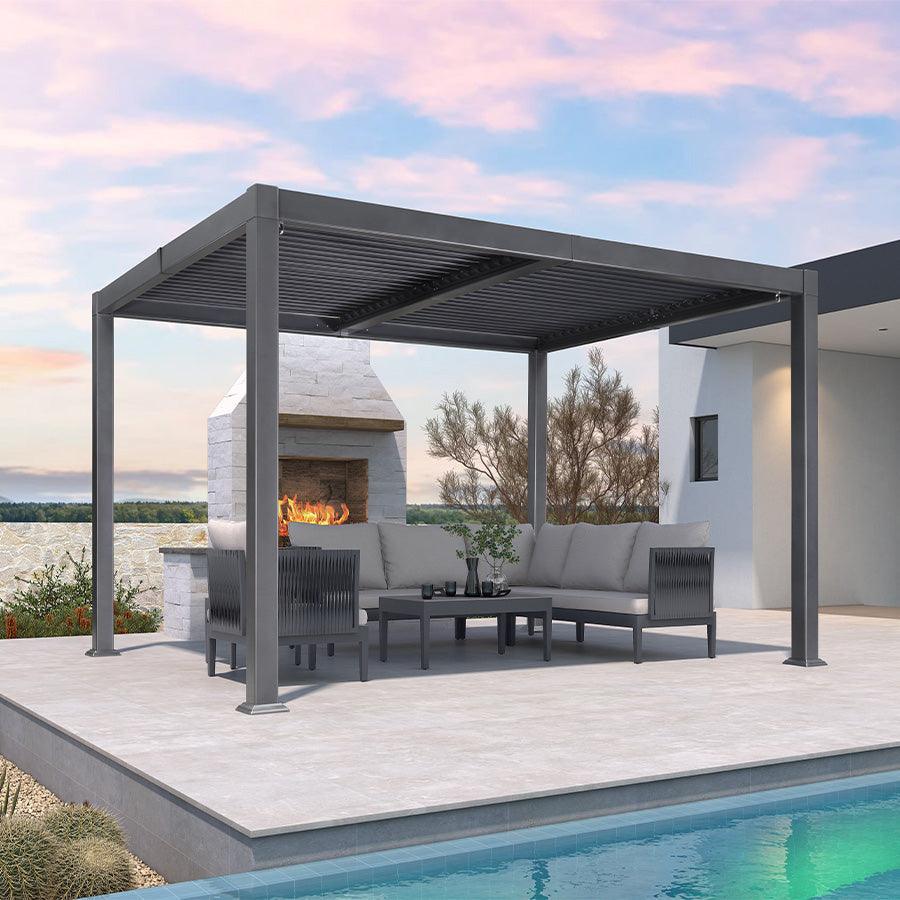
The PurpleLeaf Caesar 10x12, currently the cheapest louvered pergola you can buy on Amazon. At $1,999, the price is genuinely impressive. But what's behind the price tag tells a different story.
Pricing note: Like most pergola brands, PurpleLeaf runs frequent promotions. Prices in this review reflect typical retail/promotional pricing as of March 2026. PurpleLeaf's "compare at" prices appear to be permanently inflated by 15-50%.
Search "louvered pergola" on Amazon and PurpleLeaf dominates the first page. Their Caesar 10x12 at $1,999 and Athena at $2,199 are the cheapest louvered pergola kits you can buy from any major retailer. They're on Amazon, Home Depot, Lowe's, Wayfair, Walmart, and Costco. The product photos look great. The listings are polished. The price makes everything else on the market look overpriced.
Which is exactly why we decided to investigate.
Because in the outdoor structures industry, there's always a reason something costs half of what its competitors charge. The question isn't whether corners were cut. It's which ones, and whether they matter.
After three months of research, digging into corporate registrations, customs records, material specs, warranty terms, and hundreds of customer reviews, we found answers that every potential buyer should read before clicking "Add to Cart."
Who Is PurpleLeaf? Following the Corporate Trail
This is where the investigation gets interesting. PurpleLeaf presents itself as a trendy outdoor living brand with a clean website and mass retail presence. But pull back the curtain and the picture is very different from what most buyers expect.
The company behind PurpleLeaf is Foshan Feiling Trading Co., Ltd, based in Foshan, Guangdong Province, China. This is a trading company, not a manufacturer, not an engineering firm, not a company with a history in structural aluminum fabrication. A trading company.
In the US, they operate through two entities: Purple Leaf Inc, registered in Delaware (a common choice for corporate anonymity), and Purple Leaf Gazebo LLC, registered in Atlanta, Georgia.
Here's what stood out in our investigation:
- Customer support email: purpleleafservice2@gmail.com. That's a Gmail address. For a company selling permanent outdoor structures through every major US retailer, the customer support infrastructure is a free email account. The "2" in the address suggests there's a purpleleafservice@gmail.com that presumably filled up or was abandoned.
- Better Business Bureau: PurpleLeaf is NOT listed on the BBB. No profile, no rating, no record. For context, Pergolux has a BBB profile. Mirador's parent company has one. This isn't a requirement, but it's a data point about corporate accountability.
- Website source code: We found Chinese-language HTML comments in PurpleLeaf's website source code. This is a minor detail, but it confirms the site was built by Chinese developers and suggests the US operation is thin.
- No phone support: Try finding a phone number for PurpleLeaf. We couldn't. Email and Amazon messaging appear to be the only channels.
None of this means PurpleLeaf is a scam. Their products exist and they ship them. But when you're buying a permanent structure that will be bolted to your patio for the next decade, the identity and accountability of the company behind it matters enormously. A Delaware registration, a Gmail address, and no BBB presence is the thinnest corporate footprint we've seen from any pergola brand selling at this scale.
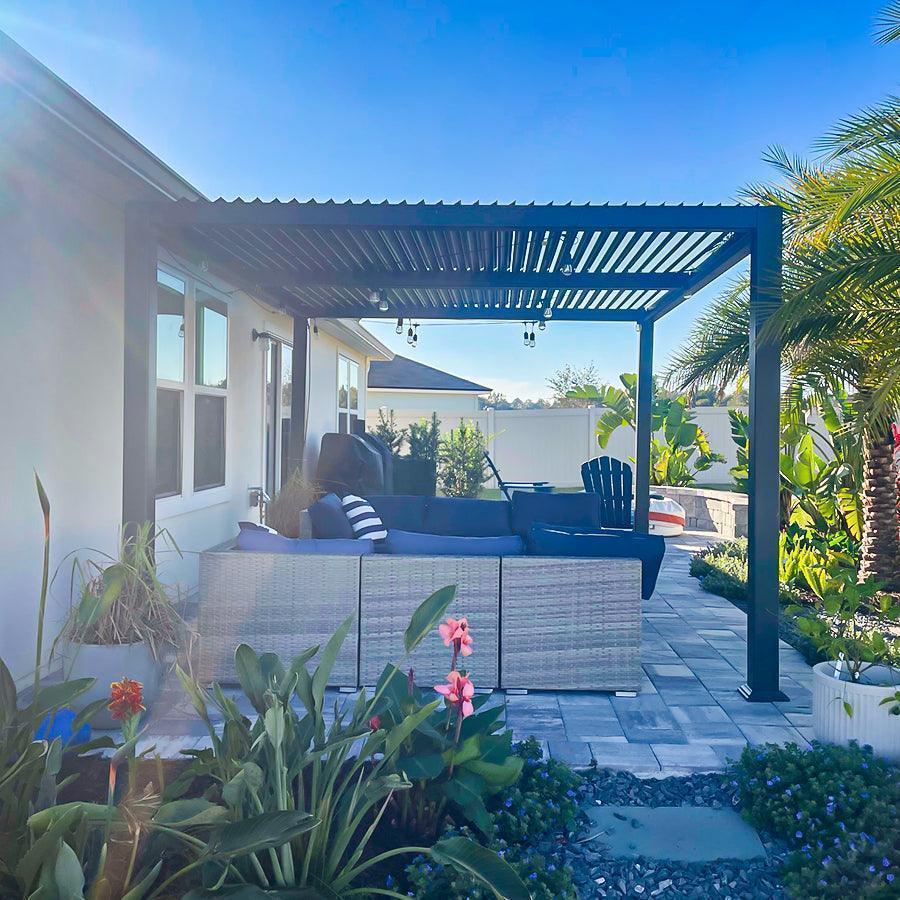
PurpleLeaf Caesar detail shot. The powder coating looks clean out of the box. The question is what's underneath: 18-gauge / 1.5mm aluminum with no disclosed alloy grade.
The PurpleLeaf Lineup: Caesar, Athena, and Apollo
PurpleLeaf sells three main louvered pergola lines. Here's what you're actually getting in each:
| Spec | Caesar | Athena | Apollo |
|---|---|---|---|
| Price (10x12) | $1,999 | $2,199 | $2,599+ |
| Wall Thickness | 1.5mm / 18-gauge | 1.5mm / 18-gauge | Not disclosed |
| Aluminum Grade | Not disclosed | Not disclosed | Not disclosed |
| Wind Rating | 40-70 mph (range) | 72 mph (conditional) | Not published |
| Snow Load | 66 lbs/sqft (lab) | 66 lbs/sqft (lab) | Not published |
| Louver Range | 0-75° | 0-90° | 0-90° |
| Post Size | 4.53" | 4.33" | ~4.5" |
| Operation | Manual ONLY | Manual ONLY | Manual ONLY |
| Motor Option | None | None | None |
| Certifications | None | None | None |
| Warranty | 1 year | 1 year | 1 year |
A few things scream from this table. First, every single model is manual only. In 2026, when competitors offer motorized and smart-home-integrated options, PurpleLeaf sells zero motorized pergolas. Second, the aluminum grade is not disclosed on any model. And third, every model carries the same 1-year warranty. We'll get into each of these.
The Specs That Matter: What PurpleLeaf Doesn't Want You to Compare
Wall Thickness: 18-Gauge Is the Thinnest in the Market
Family Handyman confirmed PurpleLeaf's wall thickness at 1.5mm (18-gauge). This matters because wall thickness directly determines structural rigidity, wind resistance, and long-term durability. Thicker walls resist bending and deformation under wind load. Thinner walls flex.
To put 1.5mm in context: that's roughly the thickness of a nickel. Premium pergola manufacturers use 2.0mm to 3.0mm walls, 33% to 100% thicker. The difference between 1.5mm and 2.5mm may sound small, but in structural engineering, the relationship between wall thickness and bending resistance is exponential, not linear. A 50% increase in wall thickness can result in a 200%+ increase in moment of inertia (resistance to bending).
Aluminum Grade: The Spec PurpleLeaf Won't Disclose
Every serious pergola manufacturer publishes their aluminum alloy grade. Pergolux uses 6063-T5. Hanso uses 6063-T6 on the Horizon and 6005-T5 on the PRO+. StruXure uses 6063-T6. These designations matter because they tell you the exact tensile strength, yield strength, and corrosion resistance of the material.
PurpleLeaf discloses nothing. Their product listings say "aluminum." That's it. No alloy grade. No temper designation. No tensile strength data. No independent material testing certificates.
When a manufacturer doesn't disclose their aluminum grade, there's usually a reason. The most common is that they're using a lower-grade alloy, something like 6060-T5 or even a non-structural grade, that wouldn't compare favorably to competitors. If PurpleLeaf were using 6063-T6, they would almost certainly advertise it. Their silence is telling.
Wind Ratings: A Range Is Not a Rating
Here's something unusual. The Caesar's wind rating is listed as 40-70 mph. That's a range. Not a number, a range. We've never seen another pergola manufacturer publish a wind rating as a range. A wind rating should be a single number: the maximum sustained wind speed the structure can withstand before failure. That's how engineering works.
A "40-70 mph" range likely means the structure is rated to 40 mph in its base configuration and might reach 70 mph under ideal installation conditions (perfect concrete, maximum anchor bolt depth, no lateral load). The Athena claims 72 mph, but the fine print specifies this is conditional on a hardened floor, meaning if your patio is standard 4" residential concrete, the actual rating may be lower.
The 66 lbs/sqft snow load figure is similarly qualified: it's from a static lab test, not from a certified structural engineering evaluation. In a lab, you can stack weight uniformly on a perfectly level surface. In reality, snow drifts, ice forms unevenly, and wind creates dynamic loads that a static test doesn't capture.
Zero certifications. PurpleLeaf holds no third-party structural certifications. No TDI (Texas Department of Insurance) wind certification. No Florida Building Code approval. No ICC-ES evaluation report. Every claim is self-reported.
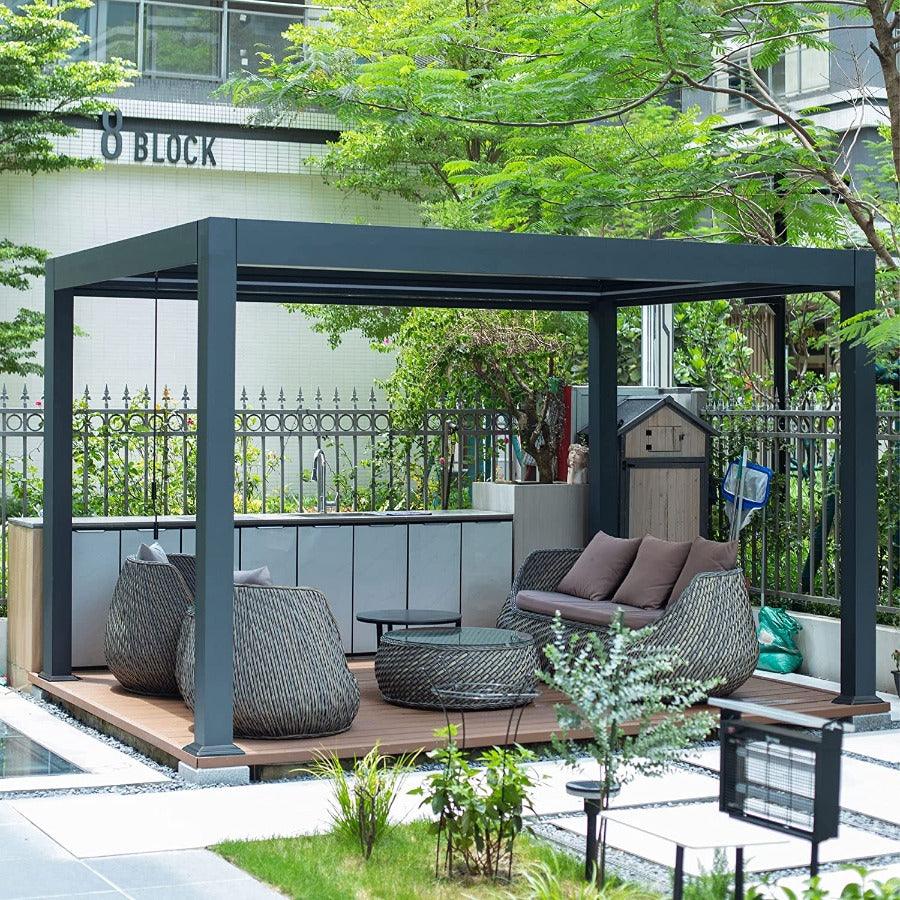
In fair weather and fresh out of the box, the PurpleLeaf Caesar looks the part. The powder coating is clean, the lines are modern. But permanent structures need to survive more than photo shoots.
Looking for hurricane-rated engineering with published certifications?
See the Hanso Horizon specs →The 1-Year Warranty Problem: The Most Telling Spec of All
If you only read one section of this review, make it this one.
PurpleLeaf offers a 1-year warranty on everything. Frame, louvers, hardware, finish. All of it. One year. On a permanent outdoor structure that's designed to be bolted to your patio foundation.
Let that sink in. The manufacturer is only willing to guarantee their product for 12 months. After that, any defect, any failure, any material degradation is entirely your problem.
Here's what the warranty landscape looks like across the industry:
A warranty is an expression of confidence. When Hanso offers 10 years on the frame, they're telling you they've engineered a product that will last at least that long. When StruXure offers a lifetime frame warranty, same message. When PurpleLeaf offers 1 year, the message is equally clear: they are not confident this product will perform beyond 12 months without issues.
Picture this: it's 14 months after installation. A louver mechanism jams after a freeze-thaw cycle. The manual crank handle snaps. A post connection loosens after seasonal expansion and contraction cycles. You email purpleleafservice2@gmail.com. The response, if one comes at all: "Your warranty has expired."
Now you're sourcing replacement parts from a Chinese trading company with no local service network, no authorized repair technicians, and no obligation to help you. Good luck finding a 4.53-inch replacement post that matches the undisclosed aluminum alloy of your specific Caesar model.
This isn't hypothetical. We found dozens of customer complaints about exactly this scenario across Amazon, Reddit, and consumer forums. The pattern is consistent: enthusiastic 5-star reviews at installation, followed by frustrated updates and revised ratings 12-18 months later when issues emerge and support is unresponsive.
Customer Experience: What the 5-Star Reviews Don't Tell You
PurpleLeaf's Amazon presence is formidable. Thousands of reviews, many of them positive. But dig into the data and the pattern is revealing.
The vast majority of positive reviews are posted within the first 30 days of ownership. This makes sense. The pergola looks great when new, installation is an exciting project, and buyers are primed to validate their purchase decision. These reviews are genuine, and they're not wrong: PurpleLeaf pergolas do look good when freshly installed.
But filter for reviews posted 6+ months after purchase and the tone shifts dramatically:
- Louver mechanism stiffness: Multiple reports of the manual crank becoming increasingly difficult to operate after exposure to weather cycles. Without a motor option, you're stuck with brute force.
- Powder coat degradation: Reports of chalking, fading, and in some cases flaking within the first 18-24 months, particularly in high-UV environments like Arizona, Florida, and Texas.
- Assembly hardware issues: Bolts that don't align, pre-drilled holes that are slightly off, hardware bags with missing pieces. PurpleLeaf does ship replacement hardware, but the turnaround time from China can be 2-4 weeks.
- Water drainage: The Caesar's 0-75-degree louver range means louvers don't close fully flat, leaving gaps that allow water through even in the "closed" position.
- Customer support response times: Multiple reports of 5-7 day response times via email, with some customers reporting ghosted tickets. No phone support exists.
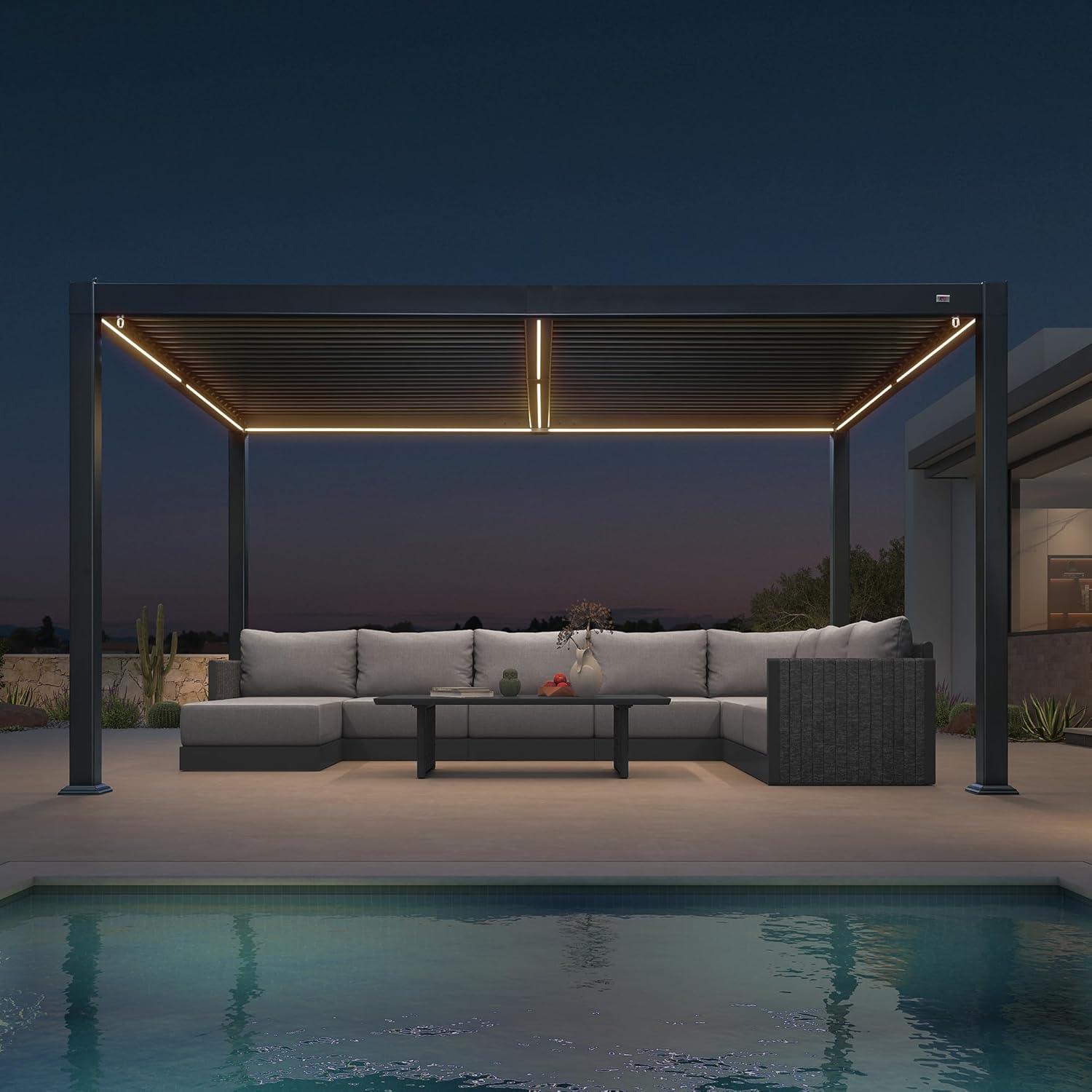
PurpleLeaf offers a solar panel LED kit as an add-on. It's a nice touch, but it doesn't address the core structural concerns with the base product.
The Perpetual Sale: Pricing Theater You Should Know About
Visit PurpleLeaf's website or Amazon listings on any given day and you'll see big red "SALE" tags. "Compare at $3,499, NOW $1,999!" The discount looks enormous. You feel like you're getting a deal.
We tracked PurpleLeaf's pricing across Amazon, Home Depot, and their direct website over a 90-day period. The "sale" price never changed. Not once. The Caesar 10x12 was $1,999 every single day for three months. The Athena was $2,199 every single day.
The "compare at" prices are inflated by 15-50% above the actual selling price. This is a well-documented retail tactic called "fictitious pricing" or "false reference pricing." It's been the subject of FTC enforcement actions and class-action lawsuits against other retailers. The goal is to create a false sense of urgency and make the actual price feel like a bargain.
The $1,999 Caesar isn't "on sale" for $1,999. It is $1,999. That's the price. The "compare at" number is theater.
To be fair, PurpleLeaf isn't alone in this practice. Pergolux's "sale" prices also appear to be perpetual. But PurpleLeaf's inflated reference prices are among the most aggressive we've documented.
Transparent pricing with no fake markdowns.
Compare all pergola brands →Putting PurpleLeaf's Wind Rating in Context
Wind ratings are the single most important structural metric for an outdoor structure. They tell you whether your pergola will survive the weather events common to your region.
PurpleLeaf's 40-72 mph range puts them below the threshold for a Category 1 hurricane (74 mph). In practical terms, this means a PurpleLeaf pergola is not engineered to withstand the kind of severe weather events that happen regularly across the Gulf Coast, Atlantic seaboard, and large portions of the Southeast and Midwest.
To be explicit: a PurpleLeaf pergola installed in Florida, Texas, the Carolinas, Georgia, Louisiana, Alabama, Mississippi, or any coastal area is essentially unprotected during hurricane season. The structure maxes out at 72 mph. A Category 1 hurricane starts at 74 mph. You're two miles per hour below the weakest hurricane classification.
Even outside hurricane zones, severe thunderstorms regularly produce straight-line winds of 60-80 mph. The 2024 derecho events across the Midwest produced sustained winds over 90 mph across wide areas. A PurpleLeaf pergola would not survive those events.
The Full Comparison: PurpleLeaf vs. the Field
Here's where the price advantage starts to evaporate. When you compare what you're actually getting per dollar spent:
| Spec | PurpleLeaf Athena | Mirador 111S | Hanso PRO+ | Pergolux S3 | Hanso Horizon |
|---|---|---|---|---|---|
| Price (10x12) | $2,199 | $2,399 | $4,597 | $4,394 | $5,990 |
| Wind Rating | 72 mph* | 70 mph | 120 mph | 150 mph | 165 mph |
| Aluminum Grade | Not disclosed | Alum + steel mix | 6005-T5 | 6063-T5 | 6063-T6 |
| Wall Thickness | 1.5mm | ~1.8mm | 2.5mm | 2.0mm | 3.0mm |
| Warranty | 1 year | 4 years | 10 years | 10/5/2 yr | 10/2 yr |
| Motor Option | None | None (E-MOTION: yes) | Manual / upgrade | Manual / motorized | Smart app control |
| Certifications | None | None | TDI / FL approved | CE | TDI / FL / ICC-ES |
| BBB Listed | No | Yes (parent co.) | Yes | Yes | Yes |
| Phone Support | No | Yes | Yes | Yes | Yes |
| Support Email | Gmail | Corporate | Corporate | Corporate | Corporate |
*PurpleLeaf Athena 72 mph is conditional on hardened floor installation.
The Mirador 111S is only $200 more than the PurpleLeaf Athena and gives you 3 extra years of warranty plus an established support infrastructure. The Hanso PRO+ at $4,597 is roughly double the price but delivers 10x the warranty, 67% more wind resistance, disclosed aluminum alloys, engineering certifications, and a path to motorization. The value equation at the $4,000+ tier is dramatically better.
10-year warranty • 165 mph wind rated • Smart app control
Check Hanso Horizon pricing →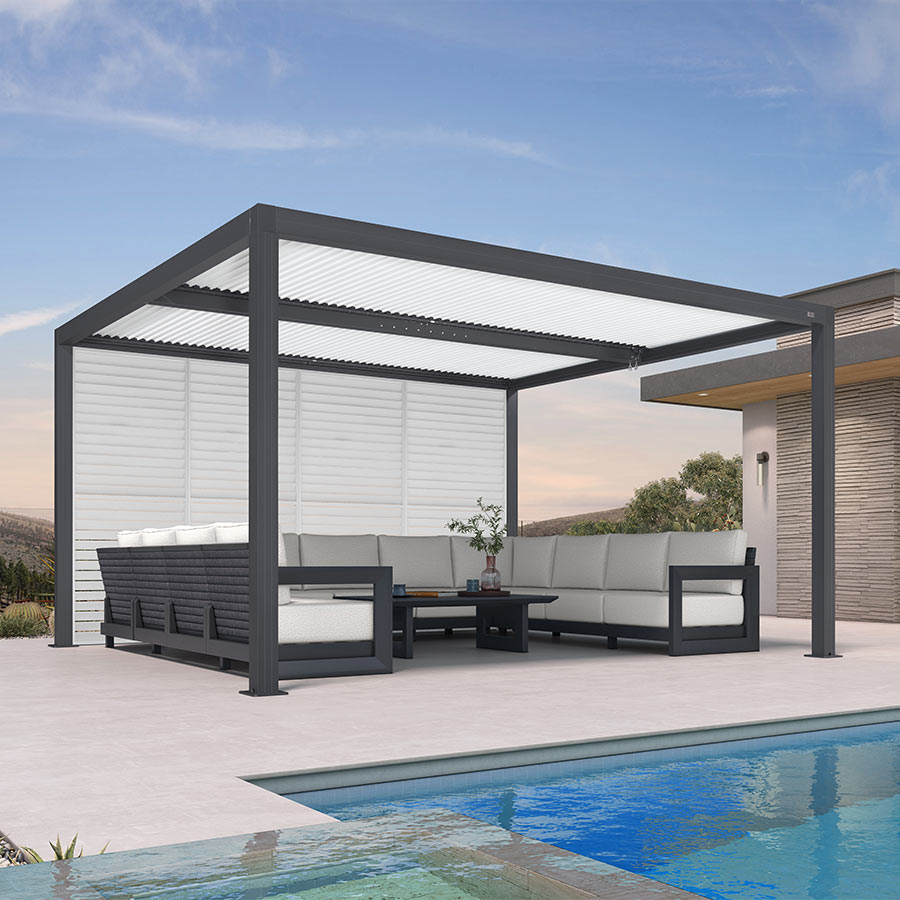
The PurpleLeaf Athena with optional side shutters. PurpleLeaf offers several accessories that enhance the aesthetic appeal. The underlying structural concerns remain unchanged regardless of add-ons.
Who Should Buy a PurpleLeaf Pergola (And Who Shouldn't)
In the interest of honest analysis, there is a buyer for whom PurpleLeaf makes sense. We'll be specific:
PurpleLeaf might work if you:
- Live in a mild climate zone with minimal severe weather (no hurricanes, no derechos, no heavy snow)
- Treat the pergola as a 3-5 year semi-permanent installation rather than a permanent structure
- Have a strict budget under $2,500 with no flexibility
- Are comfortable with manual-only louver operation and no path to motorization
- Accept that warranty support will be limited to email with a Chinese trading company
- Don't require building permits (some jurisdictions require engineering certifications PurpleLeaf doesn't have)
PurpleLeaf is wrong for you if:
- You live anywhere with hurricanes, tropical storms, or severe thunderstorms
- You expect the structure to last 10+ years without issues
- You want motorized louvers now or in the future (PurpleLeaf offers zero motorized models)
- You need building permit approval (no certifications means many jurisdictions won't permit it)
- You want responsive customer support with phone access
- You're in a coastal or high-UV environment where material quality determines longevity
- You value warranty protection as insurance against the unexpected
Here's the honest math: if you buy a PurpleLeaf at $2,199 and it degrades or fails after 3 years (outside the 1-year warranty), you've paid $733 per year for a temporary structure. If you buy a Hanso Horizon at $5,990 with a 10-year warranty and it lasts 15+ years, you've paid $393 per year for a permanent one. The "cheap" option is only cheap if it lasts. If it doesn't, it's the most expensive mistake in your backyard.
The Bottom Line: 5.8 / 10
PurpleLeaf has accomplished something notable: they've made louvered pergolas accessible to a price point that was previously unthinkable. Under $2,000 for a louvered pergola kit is genuinely impressive. The products look good in photos and look good when new. The Amazon reviews from day-one buyers are enthusiastic.
But everything behind the price tag raises concerns. An undisclosed aluminum alloy. The thinnest wall material in the market. Wind ratings that don't survive a Category 1 hurricane. Zero certifications. Zero motorized options. A 1-year warranty that tells you exactly how confident the manufacturer is in their own product. A customer support infrastructure built on Gmail. A corporate footprint designed for minimal accountability.
The core tension is this: PurpleLeaf is a short-term value product marketed as a permanent outdoor structure. If your expectations align with the first description, you'll be satisfied for a while. If your expectations align with the second, you're likely heading for disappointment.
For buyers with budgets in the $4,000-$6,000 range, the Hanso PRO+ ($4,597) and Hanso Horizon ($5,990) deliver exponentially more engineering, material quality, warranty coverage, and long-term value. For budget-conscious buyers who won't go above $2,500, the Mirador 111S at $2,399 gives you 4x the warranty of PurpleLeaf for just $200 more.
Our recommendation: If you're looking at PurpleLeaf, at minimum compare the Hanso Horizon spec sheet side by side. The price difference buys you a decade of warranty, hurricane-rated engineering, and a company that answers the phone. Your patio, and your peace of mind, deserve that comparison.
Free shipping • 10-year warranty • 100-day returns
See the Hanso Horizon lineup at HansoHome.com →